
From Skip and Loafer volume 11, Kodansha
Skip and Loafer by Kodansha is a coming-of-age ensemble story that follows Mitsumi Iwakura, a girl who leaves her rural hometown to attend high school in Tokyo. There, she meets classmates raised in the city, each with their own charm, awkwardness, distance, and quiet loneliness. The manga draws their growth with a light touch, but beneath that lightness there is always something human moving carefully beneath the surface.
The series has become a major topic of conversation through its anime adaptation, musical adaptation, and the traveling Skip and Loafer exhibition now touring across Japan. To celebrate the release of the latest volume, Volume 13, we spoke with creator Misaki Takamatsu about where the idea began and the thoughts she has folded into the work.
Profile
Misaki Takamatsu - Manga artist
Born in Toyama Prefecture in 1992. She graduated from the Department of Fine Arts in the Faculty of Art and Design at Kanazawa College of Art. In 2012, she received an honorable mention in the Autumn Contest of the Afternoon Four Seasons Awards. In 2013, she made her manga debut with Amekohime from Fusion Product. In 2015, she published the short serialization The Boat of Canaries in Kodansha’s Monthly Afternoon. Skip and Loafer, which began serialization in Monthly Afternoon in 2018, has now surpassed 3 million copies in circulation. The series placed third in Manga Taisho 2020, and in 2023 it won the General Category of the 47th Kodansha Manga Award.
Official X: https://x.com/takamatsumisaki
Synopsis
Mitsumi Iwakura comes from a depopulated town in Ishikawa Prefecture and enters a prestigious high school in Tokyo at the top of her class. She is academically gifted, yet has little experience communicating with people her own age. Slightly naive, a little offbeat, and very much herself, she gets overwhelmed by the unfamiliar rush-hour commute on the first day of school, loses her way, and falls into a panic. Then Sosuke Shima, a polished and graceful classmate from Tokyo, appears before her.
A fascination with relationships found in Ryotaro Shiba’s historical novels
Q: Skip and Loafer is a coming-of-age ensemble story that gently captures the delicate emotions particular to high school students. I heard that the original spark came from Ryotaro Shiba’s historical novels.
When I was preparing for serialization, I went through a really painful period. I kept submitting storyboards, and they kept getting rejected. During that time, hoping I might find something useful to learn from, I picked up Ryotaro Shiba’s Sekigahara.
The characters in Shiba’s novels feel almost startlingly real. Their presence has a rawness to it. Even though I was not especially knowledgeable about history, I found myself drawn in, wanting to keep reading further. Among all of that, the relationship that moved me most was the one between Mitsunari Ishida and Sakon Shima.
Mitsunari Ishida is extremely intelligent, but he has a habit of looking down on people without realizing he is doing it. He gives instructions to other warlords in a one-sided way, and when they do not understand, his attitude becomes something like, “Why can’t you understand this?” So people around him end up disliking him.
But Sakon Shima understands what Mitsunari is trying to say. He also understands that Mitsunari is not acting out of malice. He is simply bad at conveying himself. Sakon even finds something endearing in that awkwardness, in that clumsy shape of a person who cannot quite reach others even when he means to.
There was a kind of relational pull there for me. A feeling of wanting to watch two people exist in relation to each other. I thought I wanted to draw that kind of human connection in my own work.
Because I started thinking about the characters from those two historical figures, Mitsumi’s name comes from Mitsunari, and Shima’s name comes from Shima Sakon. But for a long-running serialization, I felt it would be difficult if the protagonist were disliked too much by the people around her. So I gradually changed her into a cheerful girl who is intelligent, yet also a little airheaded. As I adjusted them in that way, the traces of the original models almost completely disappeared from both of them.
Q: What was the reason for choosing high school as the setting?
At the time, I thought that in order to serialize a work in a seinen magazine, I needed some kind of hook. I felt I needed a theme with a certain level of specialization, something that would clearly give the work its identity.
But whenever I searched for a theme I could draw, I realized that I did not really have one inside myself. Each time that happened, I became depressed and thought, “Am I really this uninteresting?” I felt as though drawing only human relationships would be a form of running away. I kept thinking I had to find a real theme, something firm enough to hold the story up.
Then one day, I suddenly thought about shojo manga.
Shojo manga often centers on romance, even when there is no clear final goal set in place. Even so, the story still stands. It still moves. It still carries the reader forward. So I asked my editor, “Would it be wrong to do something like that in a seinen magazine?” They replied, “Oh, I thought you simply weren’t interested in romance stories.”
So I tried setting the story in high school. Once I did that, the proposal passed very smoothly, and it led to serialization.
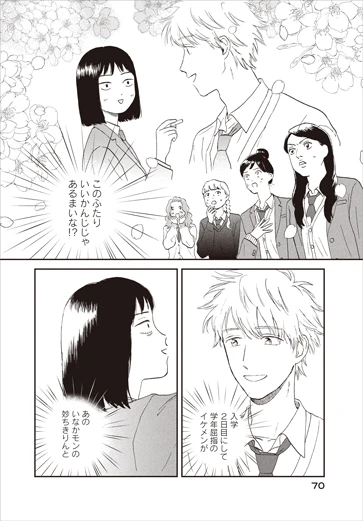
From Skip and Loafer volume 1, Kodansha
Q: The premise has a classic shojo manga shape, with a plain girl from the countryside meeting a refreshing, handsome boy from the city. But perhaps because the story is not only about romance, it has also gathered a lot of support from male readers.
I have liked shojo manga for a long time and read a lot of it, but I never really thought, “I want to have a romance like this.” I simply enjoyed reading it in the same way I enjoyed shonen manga or seinen magazines.
Because of that, I thought I was probably not suited to shojo manga myself. I thought I would not be able to draw it. With Skip and Loafer, it feels more like I borrowed a shojo manga-like premise, then rebuilt it with human relationships at the center. Since it is serialized in a seinen magazine, I have been able to work with a great deal of freedom.
Human relationships begin after the shine wears thin
Q: Why did you make Mitsumi a girl who comes to Tokyo from a depopulated rural area?
Since the starting point was Mitsunari Ishida from Sekigahara, I wanted her to be someone who stood out a little. I am from the countryside myself, so I also thought that the structure of a rural girl meeting a sparkling city boy would be something easier for me to draw.
And when I decided to work with a shojo manga-like setting, I also wanted to consciously step into a classic form. A plain, unpolished girl somehow finds herself liked by a refined, radiant boy. That is one of the familiar shapes of the genre.
At the same time, from the beginning, I wanted to follow that classic path while also looking at the parts of those classic characters that usually remain unseen. A plain girl raised in the countryside can have far more depth than people first imagine. A sparkling boy can be drawn beyond the sparkle, beyond the smooth surface, toward the human being underneath.
Q: Shima certainly appears in the first chapter as a sophisticated boy from the city, but as the story goes on, it feels as though his polished surface gradually starts to peel away.
In the context of shojo manga, the boy’s unnecessary psychological description is usually kept restrained. If he remains somewhat mysterious, he looks cooler that way. But in Skip and Loafer, I deliberately spend a lot of time drawing Shima thinking messy thoughts.
I think romance and human relationships truly begin after the shine has worn thin.
When you first meet someone, you form an image of them on your own. The more deeply you become involved with that person, the more that image changes. It shifts, loosens, sometimes breaks. Yet I feel that a true relationship is built when you continue to stay involved even after passing through that change.
That is why, with Shima, I wanted to draw him up to the point where readers might feel disappointed in him.
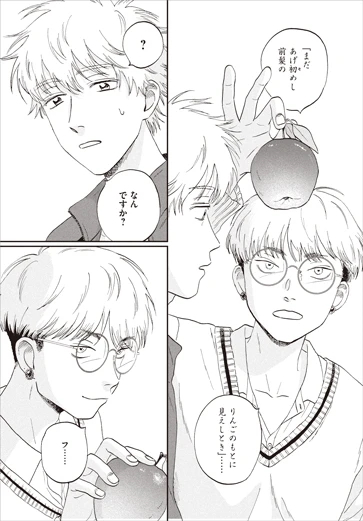
From Skip and Loafer volume 12, Kodansha
Manga needs the reassurance of giving readers what they expect. Still, if that is all there is, the story becomes tiresome. I think readers are waiting somewhere inside themselves for a moment when the story betrays their assumptions, a moment that makes them think, “So that is where it was going.”
In Skip and Loafer, I have intentionally scattered developments that overturn what readers may have assumed. I would be happy if people could enjoy the experience of the story’s texture changing as they continue reading, as though the feeling of the work itself slowly turns beneath their hands.
How much of yourself can you reveal?
Q: Beyond Mitsumi and Shima, the series has many charming characters. What do you keep in mind when creating them?
I am very careful not to side too strongly with anyone. If I favor Mitsumi too much, someone else can easily begin to look like the villain. That balance is something I always pay attention to.
Mitsumi is bright and extremely positive, but she is not a perfect saint. She fails. She hurts people. I draw her as someone who does those things too. When I create characters, I try not to lose sight of the line of whether I myself would want to be friends with them.
Q: The line Yasaka says to Mitsumi in Chapter 44 of Volume 8 is striking: “Iwakura-san, you must have been loved all your life, enough to be able to say that other people’s opinions don’t matter.”

From Skip and Loafer volume 8, Kodansha
Mitsumi grew up receiving love, so she has the strength to believe directly in her own sense of what is right. But I also think it is arrogant to simply hold up that righteousness without thinking.
Even if there is no cruelty in your heart, you can still hurt someone. Even goodwill can arrive in the wrong shape. Even something you believe to be right can wound a person in a place you did not see.
I included that scene because I wanted to show Mitsumi growing further by learning that her own kindness and sense of justice can unexpectedly hurt someone else.
Q: I heard that you also visited academically competitive high schools in Tokyo for research.
I wanted to see what a realistic high school for academically strong students was like, so I visited the school festivals of several high schools. The students I met there were all unbelievably mature. I was surprised by how composed they were.
Q: There is also the side where they are expected to be mature people. Some of them, like Shima, may not actually be that emotionally mature inside.
That is exactly right. I felt that many of them were very good at making relationships move smoothly and behaving in ways that made other people like them. But when it comes to self-disclosure, I feel that children from the countryside may be better at it.
If you grow up in an environment like Mitsumi’s, where there are only eight classmates, you have no choice but to become close. I think you also become more likely to say clearly what you are thinking.
But in the city, because the population density is higher, children are always paying attention to the people around them. It becomes harder for them to show their true feelings. As they keep trying not to stand out in an unpleasant way, they may lose track of what they actually wanted to say. They may even lose track of whether they wanted to make a claim in the first place. That vague, unsettled feeling begins to remain inside.
Of course, there are children like that in rural areas as well. But in terms of proportion, I feel that this tendency is stronger in the city.
Q: Mitsumi can reveal herself directly, while Shima keeps suppressing himself in order to maintain the version of himself that others expect. Eventually, he can no longer even understand his own true feelings. The contrast between them is very vivid.
The desire not to disappoint the people you care about is important. But if you lean too far toward that feeling, your balance begins to collapse.
Mitsumi is the type of person who can keep a balance between the self that others expect and the things she herself wants to do. Shima, by contrast, has prioritized meeting expectations too much. He has kept pushing his own feelings down. I have drawn them as people who stand opposite each other in that sense.
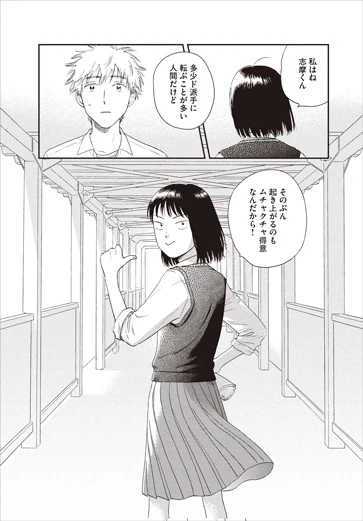
From Skip and Loafer volume 4, Kodansha
Even children who seem confident may actually be carrying something unseen
Q: Where do you find hints for your fresh and realistic portrayals of people?
Sometimes I draw by relying on my own experiences and memories. Sometimes I use what I learned through research. But it is not as if only high school students or memories from high school become useful references.
Whether someone is five years old, a middle school student, or an adult, there are moments when you can feel that person’s particular shape as a human being. Age does not really matter in those moments. Something about them comes through. So in a way, I think I use every person I meet as a reference.
There are also things I can draw now precisely because I have become more distant from adolescence. The more time passes after those years, the more the excessive self-consciousness of that time gets worn away. Feelings that were hidden back then become easier to bring out.
When I ask someone who used to be a delinquent, “How did you feel back then?” they might tell me, “Actually, it was not fun at all,” or “I wanted to enjoy things like the school festival more.”
Q: People who seem confident often may not really be that confident.
When I was in high school, makeup was forbidden, so I always went around bare-faced. At the time, I thought girls who wore makeup must love fashion and must have confidence in their own cuteness.
But when I spoke to girls who wore makeup, some of them told me that they could not even go to a convenience store without it. In a way, that means they do not have confidence in themselves. On the other hand, someone who can wake up and leave the house in five minutes may have a certain strength, a strength that comes from not worrying too much about other people’s eyes.
That made me realize that confidence cannot be measured only by how glamorous someone looks from the outside.
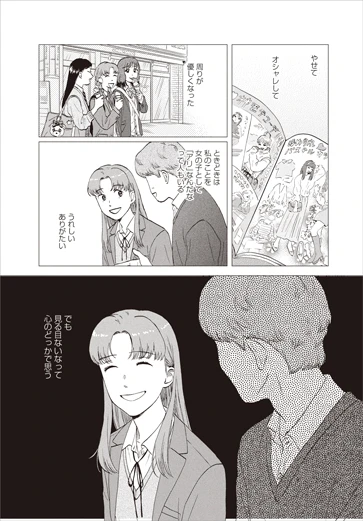
From Skip and Loafer volume 6, Kodansha
In Skip and Loafer, Shima and Mika are people who see their own value in relative terms. They are always thinking about what position they occupy, where they stand, whether other people like them.
But Mukai is the type of person who does not care where he falls in the social hierarchy, because he already has enough friends. When I look at them from an adult perspective and ask who actually has confidence, I think it is Mukai.
The danger of handing your self-worth over too much to other people is one of the themes I draw in the story.
Q: Mitsumi and the others will soon become third-year students. In the story, there is a little over a year left until graduation. How much of the ending do you already have in mind?
I never thought the series would continue this long in the first place, so I only have a vague image of where I would like them to be around the time they graduate.
I have not yet worked out the detailed story that will lead there. So while thinking about each character’s path for the future, I want to draw carefully toward the ending.
In shojo manga, entrance exams are often skipped over, and the story suddenly moves into spring and graduation. But Skip and Loafer is set in an academically competitive high school. I hope that the human drama that happens during exam preparation can become one of the things readers look forward to.
The second season of the anime is also currently in production, so I hope people will enjoy that as well.
Source: https://book.asahi.com/article/16529065, published on May 1st, 2026